
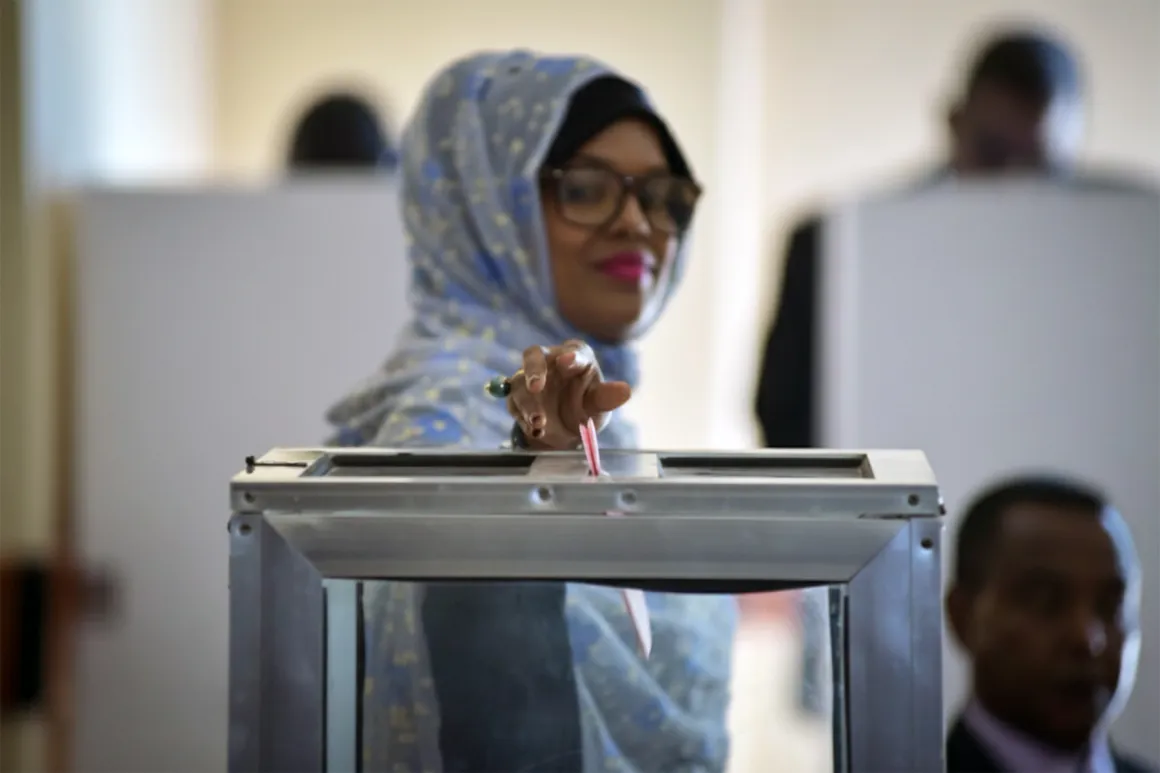
In its Resolution 2592 of 30 August 2021, and reaffirmed by its later Resolution 2632 on 26 May 2022, the UN Security Council mandated the UN to “…continue to support efforts to make progress towards the objective of universal suffrage elections, in consultation with FGS [Federal Government of Somalia] and Federal Member State [FMS] authorities, provide good offices, technical and operational support, subject to available resources, to the constitutionally mandated electoral management bodies for the conduct of free, fair, inclusive and transparent one-person, one-vote elections at the Federal Member State and district levels, in preparation for holding such elections at the federal levelin 2025, and support strengthened coordination of international electoral support to Somalia.”
The UN’s support for Somalia’s electoral process is carried out by the Integrated Electoral Support Group (IESG) – comprising experts from the UN Development Programme (UNDP) and the UN Transitional Assistance Missions in Somalia (UNTMIS) – and centred on assisting the country’s constitutionally mandated electoral management body to conduct universal suffrage elections.
UNTMIS was established on 1 November 2024, in line with the Council’s Resolution 2753, which maintains the IESG mandate, with the request to hand over its responsibilities to UN agencies in Somalia by October 2026.
Support provided in past electoral cycles
IESG has worked closely with the National Independent Electoral Commission (NIEC) since its establishment in July 2015, providing technical advice, capacity development, and infrastructure support.
With the support of donors and the UN Peacebuilding Fund, IESG has supported the NIEC in the construction of a data centre, a warehouse and an office block at the Commission’s headquarters in Mogadishu.
IESG has also assisted in the establishment of NIEC offices at the FMS level in Jubaland, South West State, Galmudug, Hirshabelle, and Puntland. The NIEC ceased to exist in 2021, while its Secretariat continued its functions and was then transferred to the National Independent Electoral and Boundaries Commission (NIEBC), which was established in December 2024.
The Federal Parliament of Somalia was formed in the 2016-2017 and 2021-2022 electoral processes through indirect electoral processes, which IESG was mandated to assist. This assistance focused on the:
Provision of technical, financial and logistical support for the organisation and conduct of the indirect electoral process;
Coordination of international partners’ support to the electoral process; and the
Provision of technical support to the advocacy for the 30 per cent women’s quota in the Federal Parliament.
More recently, in 2024, IESG supported the Ministry of Internal Affairs and Reconciliation’s legal team with technical expertise and advice on the drafting of the new legal framework, including technical support to advocate for the 30 per cent women’s quota. These efforts were also supported by the organization of trainings on Temporary Special Measures and Electoral Systems in five FMSs targeting Civil Society Organisation representatives and members of Parliamentary Committees.
Support to the NIEBC
With the revision of the first four chapters of Somalia’s Provisional Constitution in March 2024, substantial changes were made with regard to the electoral system of Somalia, the new electoral management body (the NIEBC now has 18 members and is mandated with boundary delimitation), and the requirements and roles of political associations/parties.
In November 2024, the Federal Parliament approved the law establishing the NIEBC, the Political Associations and Parties Law and the Electoral Law. This new legal framework was enacted by the Federal Parliament to regulate all future district, state and federal elections, through universal suffrage elections, also known as ‘one person, one vote” elections.
Following the establishment of the NIEBC in December 2024, IESG began its engagement with its leadership towards the organisation of district council elections. IESG’s first NIEBC induction training was conducted in February 2025 in Mogadishu.
The UN, through IESG, will support the electoral process in line with established legal frameworks and international norms and principles, including promoting the meaningful political participation of women, youth and underrepresented groups.